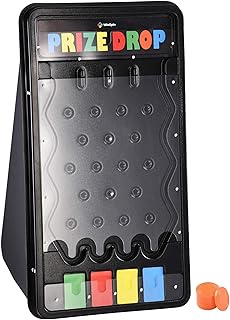
If you've ever watched a game show and felt your heart race as a disc bounced down a pegged board, you've witnessed the magic of the Plinko game. This simple yet captivating concept of chance and gravity has become a cultural icon. But what if you could bring that same nail-biting, marble-dropping excitement to your family game night? Enter the world of tabletop adaptations, where games like Mattel's classic KerPlunk game reign supreme. This article will dive into the fascinating universe of Plinko, explore its strategic depths, and reveal why a certain easy-to-learn family board game is the perfect way to experience the "don't let the marbles fall" thrill at home.
What is a Plinko Game? From TV Screens to Your Table
The classic Plinko, as popularized by the game show "The Price is Right," involves contestants dropping a chip down a large, peg-studded board. The chip plinks (hence the name!) off the pegs in a random, unpredictable path before landing in a slot at the bottom, each corresponding to a cash prize. It's a beautiful blend of pure luck and slight influencer—the initial drop point. This format has transcended TV, becoming a staple at carnivals, fundraising events, and marketing promotions as a prize drop game. The core appeal is universal: the suspenseful journey and the satisfying *clunk* at the end.
KerPlunk: The Strategic, Hands-On Plinko Experience for Families
While large carnival-style boards are fun, Mattel's KerPlunk brilliantly translates the Plinko game essence into an intimate, interactive 2-4 player game. Instead of watching a single disc fall, players actively manage an entire web of marbles poised above a basket. The setup is ingeniously simple: a transparent tube is filled with marbles, crisscrossed by a lattice of thin sticks. On each turn, players must carefully remove a stick without disturbing the marbles. The tension builds with every turn, as the lattice weakens and marbles begin to... well, kerplunk! This transforms the passive observation of Plinko into an active strategy game for kids and adults alike.
Why KerPlunk is the Ultimate Family Board Game Night Pick
Choosing the right game for a group with mixed ages can be tricky. KerPlunk succeeds where others fail because it's fundamentally an easy to learn game. The rules are grasped in under a minute: don't let the marbles fall. There's no complex reading or lengthy setup. Its appeal is visual and physical—the bright marbles, the clear tube, the tactile act of pulling sticks. This makes it perfect for younger children developing fine motor skills and strategic thinking, while still offering enough suspense to engage teens and parents. It’s a pure, shared experience of collective groans and cheers, making it a cornerstone of any family board game collection.
Mastering the Game: Strategy Beyond Luck
While luck plays a role in which marble is triggered, KerPlunk is far from mindless. Winning requires observation and calculated risk. Here are key strategies for this kids marble game that doubles as a brain-teaser:
- Scan the Structure: Before your turn, identify sticks that are supporting multiple marbles or are key to the integrity of a section. These are high-risk, high-reward.
- The Peripheral Pull: Sticks around the edges often support less weight than those in the center. Starting here can be a safer opening strategy.
- Force Your Opponent's Hand: As the game progresses, your goal shifts. Try to leave your opponent with only bad choices—sticks that will guaranteed cause a cascade. This turn-by-turn tactical thinking elevates it beyond a simple game of chance.
- Steady Hands: The physical skill of a smooth, jiggle-free pull is a strategy in itself. Practice control!
Educational Benefits: More Than Just Fun and Games
Parents and educators love KerPlunk because its fun is a vehicle for learning. As a strategy game for kids, it teaches critical thinking and planning ahead. Children learn basic physics concepts like gravity, stability, and cause-and-effect in the most hands-on way possible: if I pull this stick, what will happen? It encourages patience, fine motor control, and turn-taking. The social-emotional learning is equally valuable; kids experience winning gracefully, losing with resilience, and the joy of collaborative suspense. It proves that the best kids marble game is one that grows with the child.
Plinko vs. KerPlunk: Two Sides of the Same Thrilling Coin
While both center on the captivating drop of an object, they offer distinct experiences. The classic Plinko Game is often a solo, spectator-driven event focused on a single moment of destiny. KerPlunk is a shared, interactive battle of nerves played out over many turns. Plinko is about the drop; KerPlunk is about preventing the drop. This interactive tension is what makes the Mattel version so perfect for living rooms. It turns a moment of chance into a prolonged, engaging social activity for the whole family.
Conclusion: Bring Home the Excitement
From the glittering stage of a game show to the focused silence of your dining room table, the appeal of the Plinko game is timeless. It taps into our fascination with randomness, gravity, and suspense. For families looking to capture that magic in a tangible, replayable, and strategic format, Mattel's KerPlunk is an unparalleled choice. Its status as an easy to learn game for 2 to 4 players makes it accessible, while its hidden strategic depth ensures it never gets old. So gather the family, set up the tube, and get ready for the unforgettable sound of marbles dropping—just remember, the goal is to don't let the marbles fall!