
Since its publication in 1962, One Flew Over the Cuckoo's Nest has carved a permanent place in the canon of classic American novels. Ken Kesey's explosive narrative, set within the confines of a psychiatric ward, is far more than a story about mental illness. It is a profound exploration of individuality versus conformity, the nature of sanity, and the brutal mechanisms of institutional control. For readers and book club picks seeking a text rich with symbolism and social commentary, Kesey's work remains an essential and provocative read.
The Genesis of a Literary Earthquake: Ken Kesey and His Inspiration
The creation of One Flew Over the Cuckoo's Nest is as fascinating as the novel itself. Author Ken Kesey drew heavily from his own experiences working the night shift as an orderly at a Veterans' Administration hospital in Menlo Park, California. This firsthand exposure to the inner workings of a mental institution provided the gritty, authentic backdrop for his story. Furthermore, Kesey's voluntary participation in government-sponsored experiments with psychoactive drugs like LSD and mescaline profoundly influenced his perception of reality, consciousness, and the very definitions of 'sane' and 'insane.' These experiences coalesced into a narrative voice—that of Chief Bromden—that challenges the reader's perception of what is real and what is constructed by societal power.
Unpacking the Central Conflict: McMurphy vs. Nurse Ratched
At the heart of the novel lies one of literature's most iconic conflicts: the boisterous, rebellious Randle P. McMurphy against the calm, tyrannical Nurse Ratched. McMurphy, a gambler and felon who feigns insanity to avoid prison labor, represents unchecked, chaotic humanity. He is id, laughter, and rebellion incarnate. Nurse Ratched, the head nurse of the ward, embodies the chilling efficiency of institutional authority. Her power is not wielded through overt violence but through subtle manipulation, humiliation, and a rigid enforcement of routine designed to break the will of the patients. Their battle is not merely personal; it is a symbolic war between individual spirit and systemic oppression, a theme that continues to resonate in discussions about mental health narratives and personal freedom.
Themes That Transcend Time: Rebellion, Sanity, and Symbolism
One Flew Over the Cuckoo's Nest is layered with enduring themes. The most prominent is the critique of institutional power, where systems (the Combine, as Chief Bromden calls it) seek to homogenize and control human behavior. The novel questions who truly holds the power to define sanity, suggesting that often, it is those in control who pathologize non-conformity. Kesey also masterfully employs symbolism. The fog that Chief Bromden retreats into represents confusion and escape. The shocking electroshock therapy scenes symbolize the institution's ultimate tool for enforcing compliance. These elements ensure the novel's status as a rich subject for literary fiction analysis, offering new insights with every reading.
The Power of Narrative Voice: Chief Bromden's Perspective
A key to the novel's unique power is its narrator, Chief Bromden. A seemingly deaf and mute Native American man, Bromden provides a filtered, paranoid, yet deeply insightful point of view. His perception of the ward as a machine controlled by the 'Combine' allows Kesey to present the institution's horrors in a surreal, amplified manner. Bromden's gradual reawakening and reclaiming of his voice and strength parallel the novel's central message of resistance. His journey from observer to participant is the emotional core of the story, making the climax not just McMurphy's tragedy, but Bromden's liberation.
From Page to Cultural Icon: The Film and Lasting Legacy
The impact of Kesey's novel was magnified exponentially by Miloš Forman's 1975 film adaptation, which swept the Academy Awards. While the film is a masterpiece in its own right, it differs significantly by telling the story from McMurphy's perspective rather than Bromden's. This shift changes the story's fundamental texture, making the literary original an indispensable companion to the cinematic experience. The novel's legacy is its unwavering relevance; it continues to be a touchstone in conversations about authority, mental health care reform, and the courage of non-conformity, solidifying its place as a perennial bestseller.
Why It's a Perfect Book Club Selection
For any reading group, One Flew Over the Cuckoo's Nest is a goldmine for discussion. Its morally complex characters, ambiguous ending, and heavy themes provide endless fodder for debate. Is McMurphy a hero or a destructive force? Is Nurse Ratched purely evil, or a product of her own system? What does the novel say about society's treatment of those on the margins? Engaging with these questions makes it an ideal book club pick, guaranteed to spark passionate conversation and diverse interpretations.
Experiencing the Story Today: The Audiobook Advantage
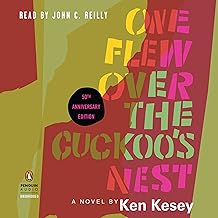
For modern readers, experiencing Kesey's prose through an audiobook format can offer a powerful new dimension. A skilled narrator can bring Chief Bromden's distinctive voice and haunting descriptions to life, emphasizing the rhythmic, almost hallucinatory quality of the writing. Hearing the chaos of the ward, the quiet menace of Nurse Ratched, and the Chief's internal monologue can deepen the listener's immersion, making the psychological landscape of the novel even more vivid and impactful.
Conclusion: An Indelible Mark on American Literature
More than six decades after its publication, One Flew Over the Cuckoo's Nest retains its raw power and urgency. Ken Kesey did not just write a novel; he issued a rallying cry for the human spirit against forces that seek to sterilize and suppress it. Its exploration of power, freedom, and identity ensures that it will continue to challenge, disturb, and inspire readers for generations to come. To truly grasp its complexity, one must return to the source—the original, groundbreaking text that started it all.



![One Flew Over the Cuckoo's Nest [DVD]](https://m.media-amazon.com/images/I/71+hOyY129L._AC_UY218_.jpg)


