
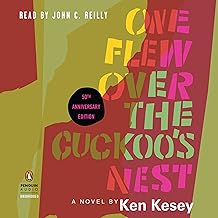
Few novels in the 20th-century literary canon have sparked as much enduring discussion, controversy, and admiration as Ken Kesey's 'One Flew Over the Cuckoo's Nest'. Published in 1962, this seminal work did more than just tell a story; it held up a fractured mirror to American society, reflecting deep-seated anxieties about authority, conformity, and the very nature of sanity. Decades later, its power remains undiminished, continuing to challenge readers and inspire debate. This exploration delves beyond a simple plot summary to examine the novel's profound and lasting cultural impact, exploring why it remains a cornerstone of literary fiction and a perennial favorite for thoughtful readers.
The Genesis of a Masterpiece: Ken Kesey's Unconventional Inspiration
To understand the raw, authentic energy of 'One Flew Over the Cuckoo's Nest,' one must look at its author's unique experiences. Ken Kesey was not merely an observer of the world he wrote about; he was an active participant. While working the night shift as an orderly at a Veterans' Hospital psychiatric ward in Menlo Park, California, Kesey gained firsthand, albeit unofficial, insight into institutional life. More famously, he also volunteered for government-sponsored experiments with psychoactive drugs like LSD and mescaline at the same hospital. These dual experiences—witnessing the mechanisms of control within a mental institution and exploring the altered states of consciousness that society deemed 'insane'—provided the volatile fuel for his narrative. The novel emerged not from detached research but from lived, experiential knowledge, giving its portrayal of the ward and its inhabitants a gritty, unsettling credibility that purely academic approaches could never achieve.
More Than a Story: The Novel as a Cultural Battleground
Upon its release, One Flew Over The Cuckoo'S Nest arrived at a pivotal moment in American history. The early 1960s were a time of simmering countercultural sentiment, pushing back against the rigid conformity of the post-war Eisenhower era. Kesey's novel became a foundational text for this movement. It framed the conflict not as one between good and evil in a traditional sense, but as a primal struggle between the individualistic, life-affirming spirit (embodied by Randle P. McMurphy) and the cold, bureaucratic, soul-crushing force of the Combine (represented by Nurse Ratched). This resonated powerfully with a generation questioning the establishment, the military-industrial complex, and societal norms. The mental ward became a potent microcosm for America itself, a place where non-conformity was pathologized and treated, often brutally.
Enduring Themes: Why the Novel Still Speaks to Us
The genius of Kesey's work lies in its timeless themes. While its 1960s countercultural context is specific, the core conflicts are universal and perpetually relevant.
The Machinery of Control and Institutional Power
Nurse Ratched is one of literature's most chilling villains precisely because her power is not overtly violent but psychological and systemic. She represents institutional authority that masks its control as care, using shame, group therapy sessions, and subtle manipulation to break patients' wills. This critique extends far beyond mental hospitals to any system—corporate, governmental, or social—that prioritizes order and docility over individual autonomy and health. Readers today can easily draw parallels to debates about surveillance, workplace culture, and social media conformity.
Redefining Sanity and Madness
The novel provocatively asks: Who is truly sane? Is it the patients, with their various traumas and coping mechanisms, or the 'sane' world that created the oppressive institution? Characters like Chief Bromden, whose narrative perspective we share, show how societal trauma (in his case, the destruction of his Native American heritage) can manifest as what the system calls madness. Kesey forces us to question our own definitions of normalcy and to empathize with those on the margins, a conversation that remains crucial in today's evolving understanding of mental health.
The Cost and Necessity of Rebellion
McMurphy's rebellion is ultimately tragic, yet it is not futile. His sacrifice awakens Chief Bromden and, by extension, the reader. The novel suggests that while challenging oppressive systems may come at a great personal cost, it is a necessary act to preserve one's humanity and to inspire others. This theme of sacrificial resistance continues to inspire movements and individuals fighting against injustice.
From Page to Icon: The Miloš Forman Film Adaptation
The novel's cultural footprint expanded exponentially with Miloš Forman's 1975 film adaptation. Starring Jack Nicholson in a career-defining role as McMurphy and Louise Fletcher as the impeccably cold Nurse Ratched, the film swept the Academy Awards, winning all five major categories (Best Picture, Director, Actor, Actress, and Screenplay). While the film is a masterpiece in its own right, it notably shifts the point of view from Chief Bromden's internal, hallucinatory narrative to a more objective, third-person perspective. This change made the story more accessible to a mass audience but also altered some of the novel's key themes, particularly the critique of the 'Combine' as a pervasive societal force. The film's success cemented the story's place in popular culture, making McMurphy and Nurse Ratched archetypal figures. For many, the film is the primary reference point, making a return to Kesey's original classic American novel a revealing experience that deepens the story's complexity.
'One Flew Over the Cuckoo's Nest' as a Book Club Phenomenon
Few books are as reliably compelling for group discussion as this one. Its status as a perfect book club pick is well-earned. The novel presents a wealth of discussable elements: morally ambiguous characters, an ending open to interpretation, and heavy ethical dilemmas. A book club might debate: Was McMurphy a hero or a reckless agitator? Is Nurse Ratched purely evil, or is she a product and enforcer of a flawed system? What is the significance of the fishing trip? How does Chief Bromden's perception shape our understanding of events? The layers of symbolism, from the machinery described by Bromden to the final act of liberation, provide endless material for analysis. Its manageable length and gripping plot also make it an accessible choice for groups, ensuring lively and often passionate conversations that connect the 1960s setting to modern-day issues of power, freedom, and care.
Critical Reception and Lasting Literary Legacy
'One Flew Over the Cuckoo's Nest' was not without its critics upon release. Some in the psychiatric community took issue with its portrayal of treatment and institutions, arguing it was a damaging caricature. Others found its language and attitudes problematic. Yet, its literary power was undeniable. It stands as a pillar of 20th-century literature, often cited alongside works by Joseph Heller, Thomas Pynchon, and Kurt Vonnegut as defining the postmodern, countercultural American voice. Its influence can be seen in subsequent works that explore institutional settings and the fragility of the mind. More importantly, it played a role in changing public perception, contributing to the movement for mental health reform and deinstitutionalization that gained momentum in the latter half of the 20th century. The novel forced a mainstream audience to look inside the walls of an asylum and question what they saw.
Conclusion: A Novel That Refuses to Be Institutionalized
Decades after its publication, Ken Kesey's 'One Flew Over the Cuckoo's Nest' refuses to be filed away as a mere period piece. Its enduring relevance is a testament to its exploration of fundamental human struggles: the individual versus the system, the definition of sanity, and the high price of freedom. It continues to sell, to be taught, and to be debated because it asks difficult questions without providing easy answers. Whether encountered as a bestseller book for the first time or revisited as an old favorite, the novel retains its capacity to shock, move, and provoke. In a world where forms of the 'Combine' still operate, and debates about individual liberty and institutional control rage on, the story of Randle P. McMurphy and Chief Bromden remains not just a classic, but a necessary and vital read.



![One Flew Over the Cuckoo's Nest [DVD]](https://m.media-amazon.com/images/I/71+hOyY129L._AC_UY218_.jpg)


