
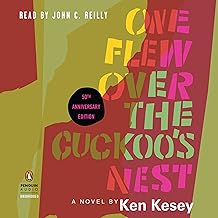
Published in 1962, Ken Kesey's One Flew Over the Cuckoo's Nest is more than just a novel; it's a cultural touchstone that challenged the very fabric of American society. The story, set in a psychiatric ward in Oregon, serves as a powerful allegory for the individual's struggle against oppressive, conformist systems. Through the unforgettable clash between the rebellious Randle P. McMurphy and the tyrannical Nurse Ratched, Kesey crafted a narrative that continues to resonate with readers decades later, questioning authority, sanity, and the nature of freedom itself. For those seeking to own this pivotal piece of literature, you can find a copy here.
The Genesis of a Countercultural Masterpiece
Ken Kesey's inspiration for One Flew Over the Cuckoo's Nest was born from direct experience. While working the night shift as an orderly at a Veterans' Hospital psychiatric ward in Menlo Park, and later as a paid volunteer in government-sponsored drug experiments at the same hospital, Kesey was granted an insider's view of institutional life. These experiences, combined with his experimentation with psychedelic drugs like LSD, which he believed offered a window into the minds of the patients, fueled his creative vision. The novel emerged from the heart of the 1960s counterculture, a movement that prized individual liberty and questioned established power structures, making it the perfect vessel for Kesey's explosive themes.
Unpacking the Central Conflict: McMurphy vs. The Combine
At its core, the novel presents a battle between two opposing forces. Randle P. McMurphy, a boisterous, gambling, rule-breaking new patient, represents unadulterated, chaotic humanity. He is id, emotion, and freedom incarnate. Standing against him is Nurse Ratched, the cold, calculating, and manipulative head nurse. She is the face of "The Combine," a term used by Chief Bromden to describe the dehumanizing, mechanized system of society that seeks to control and normalize individuals. The psychiatric ward becomes a microcosm for this larger societal struggle, where treatment is less about healing and more about enforcing submission.
The Symbolism of Chief Bromden's Narrative
The story is uniquely narrated by Chief Bromden, a seemingly deaf and mute Native American patient. His perspective is crucial. Bromden's hallucinations of a mechanized, fog-dispensing hospital represent his (and Kesey's) view of a society that strips people of their individuality. His eventual recovery of his voice and strength parallels the awakening of the other patients under McMurphy's influence. Bromden's final act of liberation—escaping the ward—is the novel's ultimate symbol of hope and resistance against The Combine.
Enduring Themes in One Flew Over the Cuckoo's Nest
The power of Kesey's work lies in its exploration of timeless, universal themes:
- Individualism vs. Conformity: This is the novel's central theme. McMurphy's rebellion is a fight for the right to be one's flawed, authentic self against a system that demands docile uniformity.
- The Nature of Sanity and Insanity: Kesey brilliantly blurs these lines. Who is truly "sane"? The rebellious McMurphy, or the coldly "rational" Nurse Ratched? The novel suggests that institutional definitions of madness are often tools for control.
- Institutional Power and Abuse: The ward exposes how institutions can corrupt, using treatments like electroshock therapy and lobotomies not for care, but as punishments to break the human spirit.
- Masculinity and Emasculation: The male patients are systematically emasculated by Nurse Ratched's maternal yet domineering authority. McMurphy's arrival reinjects a sense of traditional, if flawed, masculine camaraderie and challenge.
From Page to Icon: The Film Adaptation and Legacy
The 1975 film adaptation, directed by Miloš Forman and starring Jack Nicholson as McMurphy and Louise Fletcher as Nurse Ratched, cemented the story's place in popular culture. The film won all five major Academy Awards (Best Picture, Director, Actor, Actress, and Screenplay). While it condenses the story and shifts the point of view from Bromden, it powerfully captures the novel's spirit. Both the book and the film have sparked endless discussions in literature and film studies classes, and the character of Nurse Ratched has become an archetype for bureaucratic evil. Exploring the themes of this classic is a journey into the heart of American rebellion, and you can begin that journey with the original text available here.
Why One Flew Over the Cuckoo's Nest Remains Relevant Today
Over sixty years after its publication, One Flew Over the Cuckoo's Nest retains its shocking relevance. Its critique of institutional overreach, the subtle mechanisms of control in everyday life, and the societal pressure to conform resonates in discussions about mental health care, corporate culture, political systems, and digital surveillance. The novel asks a perennial question: At what point does the need for order destroy the human soul? It serves as a cautionary tale and a rallying cry for preserving individuality. For readers interested in powerful narratives that challenge the status quo, this novel is an essential entry in the canon of American Fiction.
In conclusion, One Flew Over the Cuckoo's Nest is a masterpiece of allegorical fiction. It is a brutal, funny, and profoundly tragic exploration of the human condition. Ken Kesey didn't just write a story about a mental hospital; he held up a mirror to society, and the reflection it shows continues to challenge, disturb, and inspire readers to question the world around them and the price of their own freedom.


![One Flew Over the Cuckoo's Nest [DVD]](https://m.media-amazon.com/images/I/71+hOyY129L._AC_UY218_.jpg)


