
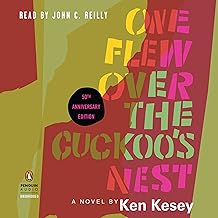
Few novels have carved a place in the cultural consciousness as deeply as Ken Kesey's 'One Flew Over the Cuckoo's Nest'. Published in 1962, this landmark work of literary fiction transcends its setting within a mental institution to deliver a powerful, enduring commentary on individuality, authority, and the human spirit. More than just a bestseller, it has become a cornerstone of 20th-century literature, sparking discussions in classrooms and living rooms for over six decades. Its status as a book club favorite is a testament to its rich layers and provocative questions, which remain startlingly relevant today.
What is it about this story that continues to resonate? At its heart, One Flew Over The Cuckoo'S Nest is a battle for the soul. The conflict between the rebellious Randle P. McMurphy and the tyrannical Nurse Ratched represents a universal struggle between chaotic freedom and oppressive control. Kesey, drawing from his own experiences working in a mental health facility, crafted a narrative that challenges readers to examine where they draw the line between sanity and madness, conformity and rebellion. This exploration solidifies its place as a definitive classic American novel.
The Genesis of a Masterpiece: Ken Kesey's Vision
The creation of 'One Flew Over the Cuckoo's Nest' is as fascinating as the novel itself. Ken Kesey was not merely an observer but an experiential writer. His time working the night shift at a Veterans Administration hospital in Menlo Park, coupled with his voluntary participation in government-sponsored drug experiments involving LSD and other psychoactive substances, profoundly shaped his perspective. These experiences allowed him to question the very nature of perception and reality—themes that pulsate through the novel's core.
Kesey approached the world of the mental institution not with clinical detachment, but with a radical empathy. He saw the patients not as case studies, but as individuals whose responses to a broken system were often more 'sane' than the mechanisms of control imposed upon them. This insider viewpoint, blurred further by his psychedelic explorations, enabled him to write with an authenticity that purely research-driven accounts could never achieve. The novel became a vessel for the countercultural currents of the early 1960s, questioning all forms of institutional authority, from the medical establishment to the government.
Deconstructing the Ward: Characters as Archetypes
The power of Kesey's mental institution drama lies in its unforgettable characters, who function both as deeply drawn individuals and powerful symbols.
Randle P. McMurphy: The Gambling Rebel
McMurphy enters the ward as a force of nature. A gambler and a brawler who chooses the asylum over a prison work farm, he represents unvarnished, chaotic life. His laughter, his confidence, and his refusal to be cowed by Nurse Ratched's system act as a catalyst. He is not a traditional hero; he is flawed, manipulative, and self-interested. Yet, his genuine connection with the other men and his willingness to fight their battles for them elevate his rebellion into something heroic. He teaches them to reclaim their voices, their laughter, and their humanity, making the ultimate sacrifice in the process.
Nurse Ratched: The Mechanism of Control
If McMurphy is chaos, Nurse Ratched is cold, calculated order. She is the embodiment of the Combine—Kesey's term for the oppressive, conformist machinery of society. Her power is not derived from physical strength but from psychological manipulation, subtle humiliation, and bureaucratic control. She maintains her authority by fostering shame, doubt, and division among the patients. Ratched is a terrifying villain precisely because her methods are so insidiously quiet and institutionalized. She represents a system that pathologizes individuality and demands submission.
Chief Bromden: The Silent Narrator
The story is filtered through the perspective of Chief Bromden, a towering Native American man who has pretended to be deaf and dumb for years. His narration is key to the novel's genius. Through his eyes, we see the ward not just as a physical space but as a mechanistic nightmare—the 'Combine' at work. His growing awareness and eventual reclamation of his own strength and voice mirror the journey of the entire ward. Bromden's final act is not one of despair, but of liberation and hope, carrying McMurphy's spirit into the world.
Enduring Themes: Why the Novel Still Speaks to Us
The continued relevance of One Flew Over The Cuckoo'S Nest can be traced directly to its exploration of timeless, universal themes.
- Institutionalization vs. Individuality: This is the novel's central conflict. It asks how systems—be they medical, educational, or governmental—can strip away personal identity and enforce conformity. The patients' gradual awakening under McMurphy's influence is a powerful metaphor for resisting any force that seeks to homogenize the human spirit.
- The Nature of Sanity: Kesey brilliantly turns the question of sanity on its head. Who is truly 'insane'? The men reacting to their oppression, or the seemingly 'sane' system that oppresses them? The novel suggests that in a sick society, the healthiest response might appear as madness.
- Silence and Voice: From Chief Bromden's pretended muteness to the stuttering Billy Bibbit, communication is a site of struggle. Finding one's voice, both literally and metaphorically, is equated with reclaiming power and humanity.
- Sacrificial Leadership: McMurphy's arc follows a classic sacrificial pattern. His rebellion, which begins as self-serving gamesmanship, evolves into a genuine mission to free the others, culminating in a Christ-like sacrifice that ultimately breaks Nurse Ratched's control and allows Bromden to escape.
From Page to Icon: The Cultural Legacy
The impact of Ken Kesey's novel extends far beyond the printed page. The acclaimed 1975 film adaptation, directed by Miloš Forman and starring Jack Nicholson and Louise Fletcher, swept the Academy Awards, cementing the story's place in popular culture. While the film is a masterpiece in its own right, it notably shifts the point of view from Chief Bromden to a more objective third-person perspective, altering some of the novel's key psychological nuances.
This story has become a touchstone in discussions about mental health care reform, patient rights, and the ethics of authority. Its title and characters are routinely referenced in political and social commentary as shorthand for bureaucratic oppression and heroic resistance. For any book club delving into its pages, the discussion inevitably turns from the 1960s setting to modern parallels, proving the novel's unsettling prescience.
Why Your Book Club Should Read It
If you're looking for a book club favorite that guarantees a passionate, multifaceted discussion, look no further than this classic. It offers endless avenues for exploration: character motivations, symbolic interpretations (the fog, the machinery, the fishing trip), narrative reliability through Bromden's eyes, and comparisons between the novel and the film. Discussing the moral ambiguity of both McMurphy and Ratched can lead to profound debates about leadership, rebellion, and the price of freedom.
It also provides a historical lens to view the evolution of psychiatry and societal attitudes toward mental illness, while its core questions about power and conformity feel freshly urgent in today's world. A copy of Kesey's seminal work is more than just a book; it's an invitation to a conversation that has been ongoing for generations and shows no sign of ending.
A Testament to the Unbreakable Spirit
In conclusion, One Flew Over The Cuckoo'S Nest endures because it is, at its heart, a profoundly human story. It is a bleak, funny, tragic, and ultimately hopeful examination of what it means to resist dehumanization. Ken Kesey crafted a world that is both a specific time capsule of the mid-20th century and a timeless allegory. The battle in that psychiatric ward is a battle we all recognize—the fight to be seen, heard, and valued as an individual against forces that demand compliance. The novel's final message, delivered through Chief Bromden's escape, is that no Combine is ever fully victorious. The spirit, once awakened, can find a way to fly. That is why, decades after its publication, this powerful drama continues to captivate, challenge, and inspire readers around the globe.


![One Flew Over the Cuckoo's Nest [DVD]](https://m.media-amazon.com/images/I/71+hOyY129L._AC_UY218_.jpg)


