
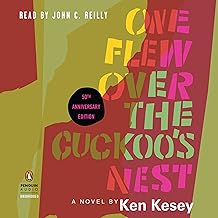
Few novels have captured the American spirit of rebellion and the complexities of institutional power as vividly as Ken Kesey's seminal work. Published in 1962, One Flew Over The Cuckoo's Nest is more than just a bestseller; it is a cultural touchstone that continues to spark debate and inspire readers decades later. This guide delves deep into the world of the Oregon psychiatric ward, exploring the unforgettable clash between the free-spirited Randle P. McMurphy and the oppressive Nurse Ratched. Whether you're a first-time reader or revisiting this classic, understanding its layers of meaning, historical context, and literary significance is key to appreciating its enduring power.
At its core, the novel is a profound exploration of sanity versus insanity, individuality versus conformity, and the human spirit's resilience against oppressive systems. Kesey, drawing from his own experiences working in a mental health facility, crafted a narrative that questions the very definitions of 'normal' and 'ill'. The story is told through the haunting perspective of Chief Bromden, a patient who pretends to be deaf and dumb, offering readers a unique and critical lens on the events unfolding within the ward's walls. This narrative choice elevates the book from a simple story of conflict to a rich, symbolic literary fiction masterpiece.
The Genesis of a Classic: Ken Kesey and His Inspiration
To fully grasp One Flew Over The Cuckoo's Nest, one must understand its creator, Ken Kesey. In the late 1950s, Kesey participated in government-sponsored experiments with psychoactive drugs like LSD and mescaline at the Menlo Park Veterans' Hospital. This experience, coupled with his job as a night aide in the hospital's psychiatric ward, provided the raw material for his novel. He witnessed firsthand the dynamics of power, the treatment of patients, and the thin line society draws between different states of consciousness. The novel emerged not just from imagination but from observed reality, lending it an authenticity that resonates with chilling clarity.
Kesey was also a key figure in the 1960s counterculture movement, and this ethos permeates every page. The character of McMurphy is a direct embodiment of the rebellious, libertarian spirit that challenged post-war American conformity. The book was a product of its time, yet its themes of institutional control, the medicalization of non-conformity, and the fight for personal autonomy are, unfortunately, timeless. Reading this analysis alongside the novel can provide deeper insights into how Kesey's personal journey shaped this defining work of classic American novel literature.
Unpacking the Central Themes and Symbolism
One Flew Over The Cuckoo's Nest operates on multiple levels, rich with symbolism and layered themes. The psychiatric ward, known as the 'Combine,' is a microcosm of society itself—a machine designed to grind down individuality and enforce a bland, obedient norm. Nurse Ratched represents the cold, bureaucratic face of this power, using subtle manipulation, shame, and enforced medication to maintain control. Her battle with McMurphy is not merely personal; it's an archetypal struggle between chaotic, life-affirming freedom and sterile, life-draining order.
Key themes include:
- Institutional Power vs. Individual Freedom: The novel is a stark critique of any system—be it psychiatric, governmental, or social—that seeks to suppress human spontaneity and will.
- The Nature of Sanity: Kesey provocatively suggests that the patients, in their vulnerability and honesty, may be more 'sane' than the so-called rational world that condemns them.
- Silence and Voice: Chief Bromden's pretended muteness symbolizes the disenfranchisement of the marginalized. His regained voice at the novel's climax represents a reclaiming of identity and power.
- Masculinity and Emasculation: The ward, under Ratched's rule, systematically strips the male patients of their confidence and agency, a process McMurphy violently and comically rebels against.
These themes ensure the novel's place as essential mental health fiction, prompting readers to reflect on how we treat those deemed 'different.'
Character Deep Dive: McMurphy, Ratched, and Chief Bromden
The unforgettable characters are the engine of the novel's power. Randle P. McMurphy is a gambler and brawler who feigns insanity to escape a prison work farm. His arrival is an earthquake in the orderly ward. He is flawed, selfish, and often reckless, but his genuine warmth, humor, and refusal to be broken ignite a spark of hope in his fellow patients. He represents the untamed, pre-industrial American spirit, a force that the modern 'Combine' cannot tolerate.
Nurse Mildred Ratched is one of literature's great antagonists. Her power lies not in overt cruelty but in a calm, calculated, and insidious form of psychological control. She represents the institutionalization of care, where efficiency and order override compassion and healing. The chilling effectiveness of her methods makes her a far more terrifying villain than any cartoonish tyrant.
Perhaps the most crucial character is the narrator, Chief Bromden. A Native American man grappling with his heritage and his perceived inadequacies, Bromden's journey from silent observer to empowered actor is the novel's emotional core. His hallucinations of the 'Combine'—a mechanistic fog that controls society—provide the book's most potent symbolic imagery. Through his eyes, we see the true cost of the war being waged in the ward.
The Enduring Legacy and Cultural Impact
The impact of One Flew Over The Cuckoo's Nest extends far beyond the printed page. The 1975 film adaptation, starring Jack Nicholson and directed by Miloš Forman, became a cinematic landmark, sweeping the five major Academy Awards. While the film is brilliant, it notably shifts the point of view from Chief Bromden to a more objective lens, altering key thematic elements. Engaging with both the original novel and the film offers a fascinating study in adaptation.
The novel's vocabulary—'the Combine,' 'Big Nurse,' 'cuckoo's nest'—has entered the cultural lexicon. It remains a staple in high school and university curricula, constantly debated for its portrayal of psychiatry, gender, and rebellion. Critics have analyzed it through feminist, Marxist, and post-colonial lenses, proving its depth and complexity. Its status as a perennial bestseller is a testament to its ability to connect with each new generation that feels the pressure to conform or questions the authority of institutions.
Why You Should Read (or Re-read) It Today
In an era of increasing discussion about mental health, systemic power, and individual rights, One Flew Over The Cuckoo's Nest is more relevant than ever. It challenges readers to question who gets to define normalcy and at what cost that definition comes. It is a heartbreaking, funny, furious, and ultimately hopeful story about the cost of freedom and the redemptive power of human connection.
Whether you are drawn to powerful character studies, social critiques, or simply masterful storytelling, this novel delivers. It is not always an easy read—its scenes are raw, its结局 is tragic—but it is an essential one. To experience the full force of Kesey's vision, there is no substitute for the original text. Discover or rediscover the power of this defining American story, and join the decades-long conversation about what it means to be truly free. For a deeper exploration of its themes and context, consider reading this companion analysis.


![One Flew Over the Cuckoo's Nest [DVD]](https://m.media-amazon.com/images/I/71+hOyY129L._AC_UY218_.jpg)


