In a world dominated by digital screens and fast-paced entertainment, there's something profoundly satisfying about the tactile click of pieces on a wooden board. Among the pantheon of classic games, Mancala stands out not just for its age—dating back thousands of years—but for its elegant simplicity and deep strategic complexity. This isn't merely a pastime; it's a global cultural artifact, a brain-teasing puzzle, and a wonderful conduit for social connection. Whether you're looking for a thoughtful two-player duel, a fun family activity, or an educational tool, understanding Mancala opens the door to a world of timeless engagement.
The Ancient Roots and Global Journey of Mancala
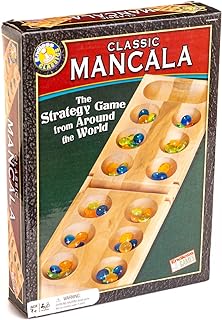
The story of Mancala is a story of human civilization itself. Archaeologists have found evidence of similar pit-and-pebble games in ancient Africa and the Middle East, with some theories suggesting origins over 3,000 years ago. The name "Mancala" itself is derived from the Arabic word "naqala," meaning "to move." As trade routes expanded, so did the game, evolving into hundreds of regional variants known by names like Oware, Kalah, Bao, and Congkak. This diffusion makes it one of the most widespread traditional games in history. Its endurance is a testament to its perfect core mechanic: easy to learn, impossible to master. Playing a modern version, like the beautifully crafted Classic Mancala board, connects you directly to this ancient lineage of strategic thinking.
How to Play Mancala: Rules Made Simple
At its heart, Mancala is a count-and-capture game. A standard board has two rows of six small pits, with a larger scoring pit (called a Mancala or store) at each end. Players begin with a set number of seeds (often 4) in each of their six pits. On a turn, a player picks up all the seeds from one of their pits and "sows" them counter-clockwise, dropping one seed into each subsequent pit, including their own Mancala store (but skipping the opponent's store). If the last seed sown lands in an empty pit on the player's side, they capture all seeds in the pit directly opposite. The game ends when one player's row is empty. The player with the most seeds in their store wins. This simple set of rules belies a game of immense foresight and calculation, making every two-player game session a fresh challenge.
Beyond Luck: The Strategic Depth of a True Thinking Game
Unlike many classic board games that rely on dice or cards, Mancala is a game of pure skill and strategy. There is no randomness once the game begins. Success hinges on planning several moves ahead, controlling the board's tempo, and executing clever captures. Advanced strategies involve creating "grand slams" (multiple captures in one turn), forcing your opponent into disadvantageous moves, and carefully managing the distribution of seeds to maintain options. This makes it an exceptional family strategy game—it levels the playing field between generations based on thought, not chance. A well-made wooden board game like the Classic Mancala enhances this experience, providing a solid, sensory platform for these mental gymnastics.
Why Mancala is the Perfect Game for Friends and Family
The social benefits of Mancala are as significant as the cognitive ones. Its quick setup and straightforward rules mean you can start playing in minutes, making it ideal for gatherings. It fosters friendly competition, conversation, and connection without the lengthy commitment of more complex games. As a timeless strategy game, it appeals to all ages—children can grasp the basics while adults engage with the deeper tactics. It's genuinely fun for friends looking for a quick yet satisfying challenge. The physical act of sowing seeds is rhythmic and calming, creating a focused yet relaxed social atmosphere that is often missing from digital interactions.
Mancala as a Powerful Educational Tool
Educators and parents have long recognized Mancala as a superb educational game. It seamlessly builds foundational math skills. Young players practice counting, addition, and subtraction with every move. More subtly, it introduces concepts of planning, resource management, and cause-and-effect. Players learn that short-term gains can lead to long-term losses, a crucial lesson in strategic thinking. The game also enhances fine motor skills and patience. Incorporating a game like the Classic Mancala into learning environments or family game nights turns skill development into an engaging, playful activity, proving that the best learning often doesn't feel like learning at all.
Choosing Your Mancala Board: What to Look For
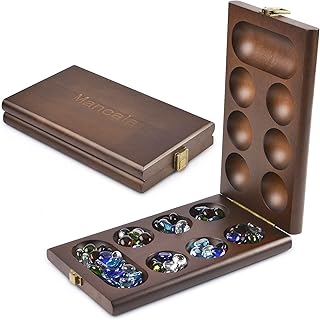
While you can play Mancala with holes in the ground and pebbles, a dedicated board elevates the experience. When selecting a set, consider material, craftsmanship, and storage. A solid wooden board game offers durability, a pleasing weight, and a beautiful aesthetic that becomes a conversation piece. The pits should be smoothly carved to allow easy pickup of seeds. The included playing pieces (often glass gems or polished stones) should be uniform and a comfortable size. A board with a built-in storage compartment for the seeds is a practical bonus. Investing in a quality set, such as the Classic Mancala, ensures the game can be enjoyed for years, becoming a cherished heirloom that carries memories of countless fun for friends and family moments.
Bringing Timeless Strategy into Your Home
Mancala is more than a game; it's a bridge across generations and cultures, a gym for the mind, and a catalyst for genuine connection. In an era of disposable entertainment, it offers enduring value. Its timeless strategy ensures it never grows old, and its social nature makes it a perennial favorite. Whether you are rediscovering it or introducing it to a new generation, a game like the Classic Mancala is a worthy addition to any home. So clear a space on the table, pour the gleaming seeds into their pits, and take part in a tradition of strategic play that has captivated humans for millennia. Your next move awaits.