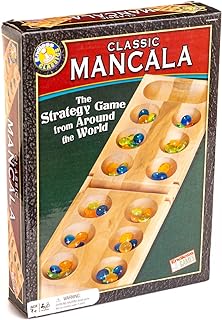
For thousands of years, the rhythmic clatter of stones or seeds dropping into carved wooden pits has captivated players across continents. This is the sound of Mancala, one of the world's oldest and most beloved strategy games. More than just a pastime, Mancala is a cultural touchstone, a brain-teasing puzzle, and a fantastic tool for developing critical thinking skills in both kids and adults. Whether you're a complete beginner curious about the rules or a seasoned player looking to refine your strategy, this comprehensive guide will walk you through everything you need to know about this timeless classic, including how to choose the perfect set for your home.
What is Mancala? A Journey Through History
The term "Mancala" actually refers to a large family of count-and-capture games, with origins tracing back to ancient Africa and the Middle East. Archaeological evidence suggests similar games were played in Egypt as early as 1400 BCE. The game traveled along trade routes, evolving into countless regional variations known by names like Oware, Kalah, Bao, and Congkak. At its heart, every Mancala board game involves a simple, elegant mechanic: moving small pieces around a board of pits to capture your opponent's pieces. This universal appeal—easy to learn, difficult to master—is why it remains a staple in households worldwide today.
How to Play Mancala: Rules for Beginners
While variations exist, the most common version played in the West is often called Kalah. The setup is straightforward. The board consists of two rows of six small pits, with a larger "store" or "Mancala" at each end. Players sit facing each other, with the six pits closest to them being their territory and the large pit on their right being their store. To start, place four pieces (often called stones, seeds, or marbles) into each of the 12 small pits. The goal is to capture more pieces than your opponent and store them in your Mancala.
Basic Gameplay & Movement
On your turn, pick up all the pieces from any one of your six pits. Moving counter-clockwise, drop one piece into each subsequent pit, including your own store but *skipping* your opponent's store. If your last piece lands in your own store, you get an extra turn. This simple "sowing" mechanic is the core of the game.
Capturing Pieces
The strategy deepens with capturing. If your last piece lands in an empty pit on your side of the board, you capture that piece *and* all the pieces in the pit directly opposite on your opponent's side. You then place all captured pieces into your store. The game ends when all six pits on one side of the board are empty. The player with the most pieces in their store wins.
Advanced Mancala Strategy: Moving Beyond the Basics
Once you understand the rules, the real fun begins. Mancala is a game of foresight, pattern recognition, and mathematical calculation. Here are key strategic concepts to elevate your play:
- Control the Board: Avoid setting up your opponent for a big capture. Think several moves ahead about where your last stone will land.
- Prioritize Extra Turns: Landing your last stone in your store grants another turn. Chain these together to execute powerful multi-move sequences.
- Defensive Play: Sometimes, the best move is one that denies your opponent a lucrative capture, even if it doesn't gain you much immediately.
- Endgame Calculation: As pits empty, carefully count stones to force the game to end on your terms, potentially stranding stones on your opponent's side.
Why Mancala is the Perfect Game for Families
In an age of screens and digital isolation, family board games like Mancala offer invaluable benefits. It's a true intergenerational activity. The rules are simple enough for a young child to grasp (typically ages 6 and up), yet the strategic depth can challenge a teenager or adult. Playing Mancala together fosters patience, turn-taking, sportsmanship, and logical reasoning. It requires no reading, making it accessible to pre-readers and a great choice for a quiet, focused game for kids and adults alike. The tactile experience of handling the smooth stones is inherently satisfying and calming.
Choosing Your Ideal Mancala Set: What to Look For
With so many sets available, selecting the right one enhances the experience. Here’s a breakdown of key features to consider, exemplified by a top-tier option like the Mancala Board Game for Kids, Adults & Family.
1. Board Material and Durability
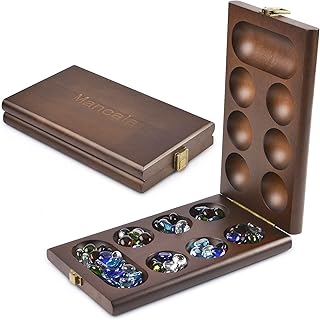
The board should feel solid and withstand frequent play. A rubber wood board is an excellent choice—it's a sustainable, durable hardwood with a beautiful natural grain that resists cracking. Avoid flimsy plastic or poorly constructed boards that can warp.
2. Portability and Storage
A great Mancala set should be easy to put away and take on the go. Look for a folding game board design. This feature is a game-changer, protecting the pieces inside when closed and making it a perfect portable travel game for road trips, camping, or visits to grandma's house.
3. Pieces (Stones/Marbles) and Count
The standard game uses 48 pieces (4 per pit). Higher-quality sets often include extras. A set with 48+10 stones, for instance, provides spares in case some are lost. The pieces should be smooth, evenly sized, and pleasant to handle—glass marbles or polished gemstones are ideal.
4. Completeness and Instructions
Ensure the set comes with clear, illustrated instructions. A well-written rulebook helps newcomers start playing immediately and may even explain a few common variants of this classic marble game.
Beyond the Living Room: Mancala as a Travel Companion
The compact, self-contained nature of a folding Mancala set makes it uniquely suited for travel. Unlike sprawling board games, it requires minimal table space—perfect for a train tray table, a picnic blanket, or a hotel room. It provides screen-free entertainment that encourages conversation and connection, whether you're on a family vacation or a weekend getaway. Its timeless appeal transcends language barriers, making it a wonderful gift or icebreaker.
Conclusion: Rediscover a Timeless Classic
Mancala is more than a game; it's a bridge between generations and cultures, a mental workout disguised as simple fun. By understanding its rich history, mastering its basic rules and advanced strategies, and investing in a high-quality, durable set like the featured folding rubber wood board, you unlock endless hours of engaging entertainment. It’s the perfect centerpiece for a family game night, a thoughtful gift, or a compact companion for your next adventure. So gather some stones, find a friend, and start sowing the seeds of your next victory.