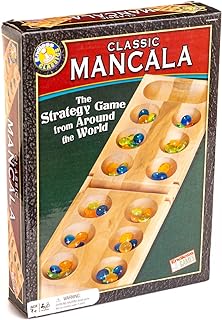
For thousands of years, Mancala has captivated minds across continents. More than just moving colorful stones, it's a battle of wits, foresight, and mathematical cunning played on a simple wooden board. Whether you're a complete beginner looking to understand the basics or a seasoned player aiming to refine your strategy, this guide will walk you through everything you need to transform from a casual player into a formidable Mancala opponent.
What is Mancala? A Brief History of the World's Oldest Game
The term "Mancala" actually refers to a large family of count-and-capture games, with origins tracing back to ancient Africa and the Middle East. Archaeological evidence suggests similar games were played in Egypt as early as 1400 BCE. The game traveled along trade routes, evolving into numerous regional variations like Oware (Ghana), Bao (East Africa), and Congkak (Southeast Asia). Its enduring appeal lies in its perfect blend of simple mechanics and deep strategic complexity, making it a timeless strategy game for all ages.
Understanding the Mancala Board and Setup
A standard Mancala board consists of two rows of six small pits, with a larger "store" or "Mancala" at each end for captured stones. Players sit facing each other, with the six pits on their side belonging to them, and their store to their right. The game begins with an equal number of stones (often four or six) placed in each of the twelve small pits. The stores start empty. The objective is straightforward: capture more stones in your store than your opponent by the end of the game.
Official Mancala Rules: How to Play Step-by-Step
Players take turns picking up all the stones from one of the pits on their side. Moving counter-clockwise, they then "sow" the stones, placing one in each subsequent pit, including their own store but *skipping* their opponent's store. This simple act of sowing is where the strategy begins. Key rules that govern play include:
- Capturing Stones: If your last sown stone lands in an empty pit on your side, and the opposite pit on your opponent's side contains stones, you capture both your last stone and all stones in the opponent's opposite pit, placing them all in your store.
- Free Turns: If your last sown stone lands in your own store, you get an extra turn.
- Ending the Game: The game ends when all six pits on one player's side are empty. The other player then gets to collect all remaining stones on their side into their store. The player with the most stones in their store wins.
Advanced Mancala Strategies to Dominate the Board
Moving beyond basic rules, true mastery of Mancala requires strategic planning. Think several moves ahead, like in chess. Here are proven tactics used by experts:
- Control the Rhythm: Aim to set up moves that give you multiple turns in a row. Landing in your store isn't just a point; it's a chance to execute a devastating combo.
- Defensive Positioning: Avoid leaving single stones in your pits, especially early in the game. A lone stone is an easy target for your opponent to capture.
- The Power of the 4th Pit: Many advanced strategies focus on controlling the pit directly opposite your store (the 4th pit from the left/right). Controlling this area can limit your opponent's options and set up captures.
- Counting and Forecasting: Constantly count the stones in key pits. Can you foresee a move that will set up a capture two turns from now? This foresight is the hallmark of an expert player.
Why a Quality Board Matters: The AMEROUS Wooden Mancala Set
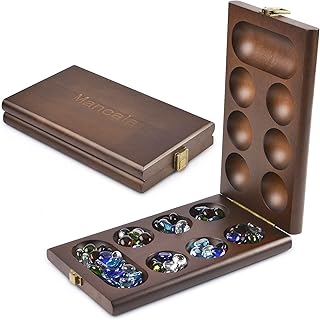
While you can play Mancala with an egg carton and beans, a dedicated board enhances the experience immensely. The AMEROUS Wooden Mancala Board Game Set is an exemplary choice for both new enthusiasts and veteran players. Its solid wooden mancala board provides a satisfying, durable playing surface that feels authentic to the game's heritage.
The set's ingenious folding board game design makes it the ultimate travel board game. It closes securely to hold all the vibrant, multi-color glass stones inside, preventing loss and making it perfect for picnics, vacations, or visits to friends. The included gift-ready packaging and clear Mancala instructions also make it a thoughtful gift for kids and adults alike, introducing them to this classic family board game.
Mancala for Kids: Educational Benefits and Family Fun
Mancala isn't just fun; it's a powerful educational tool. For children, it seamlessly builds critical skills:
- Math and Counting: Players constantly add, subtract, and plan distributions, reinforcing basic arithmetic in a engaging, hands-on way.
- Strategic Thinking: It teaches planning, consequence evaluation, and adaptive thinking—skills valuable far beyond the game board.
- Fine Motor Skills: Picking up and sowing the small glass stones helps develop dexterity and hand-eye coordination.
- Patience and Turn-Taking: As a two-player game, it's a perfect, screen-free activity that encourages social interaction and patience.
Playing with a beautiful set like the AMEROUS board turns learning into a special event, making it a staple for family board game nights.
Common Beginner Mistakes and How to Avoid Them
Even with the rules down, new players often fall into predictable traps. Here’s how to sidestep them:
- Playing Reactively: Don't just make the move that looks best right now. Always ask, "What will the board look like after my move, and what options does that give my opponent?"
- Ignoring the Opponent's Store: Keep a mental note of how close your opponent is to ending the game. Sometimes, a defensive move to prolong play is better than an aggressive move that gives them the final collection.
- Wasting the First Move: The opening move sets the tone. Avoid starting with a pit that has too few stones, as it gives you limited sowing power and control.
- Forgetting the "Empty Pit" Rule: New players often sow stones without watching where the last one lands. Always plan your move with the capture rule in mind.
Conclusion: Your Journey to Mancala Mastery Begins
Mancala is a game that is easy to learn but takes a lifetime to master. Its depth is a testament to its ancient design. By understanding the core rules, practicing the strategic principles outlined here, and playing on a quality board that invites engagement—like the portable and elegant AMEROUS set—you'll not only enjoy countless hours of challenge and fun but also connect with a piece of human history. Gather the stones, plan your moves, and embark on your strategic journey today.