For thousands of years, a simple yet profound game of strategy has captivated minds across continents. Known as Mancala, this ancient pastime is more than just moving stones around a board; it's a test of foresight, calculation, and tactical thinking. Often called the world's oldest board game, its enduring appeal lies in its elegant simplicity paired with deep strategic complexity. Whether you're a complete beginner looking to learn the basics or a seasoned player aiming to refine your strategy, this comprehensive guide will walk you through everything from the rich history of Mancala to modern gameplay tips and how to select the perfect board for your home.
The term "Mancala" itself is derived from the Arabic word "naqala," meaning "to move." It serves as an umbrella name for a family of pit-and-pebble games that originated in Africa and the Middle East. Archaeological evidence suggests similar games were played in ancient Egypt as far back as 1400 BCE. Over millennia, the game traveled along trade routes, evolving into countless regional variations like Oware (Ghana), Bao (East Africa), and Congkak (Southeast Asia). This global journey speaks to the game's universal appeal—a timeless challenge that requires no language, just logic and observation.
The Essential Rules of Mancala: How to Play
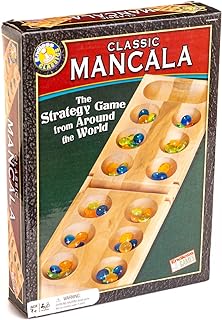
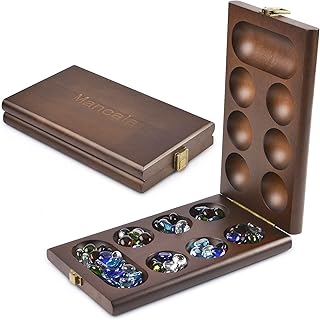
While variations exist, the most common version played in the West uses a board with two rows of six small pits (or "houses") and two larger pits at each end called "stores" or "Mancalas." The VAMSLOVE Wooden Mancala Board Game, for instance, provides this classic setup. Players start with four stones (often colorful glass pieces) in each of the 12 small pits. The objective is straightforward: capture more stones in your store than your opponent.
On your turn, you pick up all the stones from one of your six pits on your side of the board. Moving counter-clockwise, you drop one stone into each subsequent pit, including your own store but skipping your opponent's store. This simple "sowing" mechanic is the heart of the game. If your last stone lands in your own store, you get an extra turn—a crucial rule for setting up multi-turn combos. If your last stone lands in an empty pit on your side, you capture that stone and all stones in the pit directly opposite on your opponent's side, placing them all in your store. The game ends when all six pits on one side are empty. The player with the most stones in their store wins.
Mastering Mancala Strategy: From Beginner to Advanced
Moving stones randomly might get you started, but true mastery of Mancala requires strategic planning. Beginners should focus on controlling the rightmost pits on their side, as stones from these pits are more likely to land in your store for an extra turn. Always scan the board before your move: can you set up a capture by landing your last stone in an empty pit? Can you avoid leaving a pit with a single stone, making it an easy target for your opponent?
Intermediate players learn the art of "counting," mentally tracking where stones will land several moves ahead. A key advanced tactic is the "defensive setup," where you intentionally keep certain pits empty or stocked to block your opponent's capture opportunities. The game often shifts from an offensive scramble in the early and mid-game to a calculated endgame where every move is about maximizing your final haul and minimizing your opponent's. Playing a high-quality set like a wooden Mancala board with smooth, consistent pieces enhances this strategic focus, as there are no distractions from poorly made components.
Why Mancala is the Perfect Game for Families & Travel
In a world of screens and complex rulebooks, Mancala offers a refreshing analog experience. It's a superb family board game that bridges generations. Young children (typically ages 6 and up) can grasp the basic rules quickly, which builds confidence, while the strategic depth keeps teens and adults engaged. It's a fantastic tool for developing cognitive skills: counting, pattern recognition, strategic planning, and turn-taking. Unlike many two-player games that can drag on, a round of Mancala is usually quick, making it perfect for a fun break or multiple rematches.
Its portability is another huge advantage. Modern sets, especially those designed as a folding Mancala set, are ideal travel games. Look for features that prevent spills, like a magnetic lock game mechanism that securely closes the board. This ensures your stones stay put during car rides or flights, transforming any waiting room or picnic table into a gaming arena. The compact nature and lack of small, easily lost parts (when designed well) make it a far more practical travel companion than a box of scattered cards or a sprawling board.
Choosing Your Ideal Mancala Board: What to Look For
Not all Mancala boards are created equal. The right set can elevate your gaming experience from functional to fantastic. Here are key features to consider:
- Material & Craftsmanship: A wooden Mancala board offers durability, a pleasing tactile feel, and aesthetic warmth that plastic often lacks. It's an heirloom-quality item.
- Storage & Portability: A folding design with secure closure is essential. The VAMSLOVE set, for example, features a magnetic lock that snaps shut, keeping all 48+8 extra multi-color glass stones safely contained—a must for a travel game.
- Pieces (Stones): The stones should be smooth, consistent in size, and pleasant to handle. Glass stones are a premium choice, offering beautiful visual appeal as they clink during play. Having extra pieces is a thoughtful bonus.
- Clarity & Instructions: A good set includes clear instructions, helpful for beginners. The board's pits and stores should be clearly defined for easy gameplay.
When you find a set that combines these elements—like the featured wooden Mancala board with magnetic lock—you're not just buying a game; you're investing in countless hours of focused, screen-free strategy game enjoyment. It becomes a centerpiece for game nights, a quiet challenge between partners, or a thoughtful gift that teaches as it entertains.
Bringing an Ancient Game into Your Modern Home
Mancala is more than a relic; it's a living, breathing game that continues to challenge and delight. Its minimal ruleset belies a universe of strategic possibility, making every game a unique puzzle. By choosing a well-crafted board designed for both play and preservation, you honor this ancient tradition while creating new memories. Whether you're seeking a brain-teasing two-player game, a educational tool for kids, or a compact travel game, a quality Mancala set is a versatile and rewarding addition to any home. So, gather your stones, plan your moves, and discover why this ancient game of seeds and pits has stood the test of time.