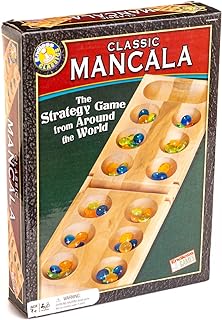
Stepping into the world of Mancala is like discovering a timeless treasure. This ancient game of seeds and strategy has captivated players for centuries, offering a perfect blend of simple rules and deep tactical thinking. However, its apparent simplicity is often a trap for new players. Many beginners fall into predictable patterns and make critical errors that more experienced opponents can easily exploit. Whether you've just unboxed a beautiful wooden Mancala board or are playing online, understanding these common pitfalls is the fastest way to elevate your game from novice to contender.
Mistake #1: Playing Randomly Without a Plan
The most fundamental error in any strategy game is moving without purpose. In Mancala, every seed you pick up and sow is a decision that ripples across the board. Beginners often grab seeds from the first pit that looks promising without considering the subsequent moves. True strategy in Mancala involves thinking at least one, preferably two or three, moves ahead. Before you pick up your seeds, ask yourself: Where will my last seed land? Will it land in an empty pit on my side, allowing me to capture? Will it give me an extra turn? Am I setting up a strong position for my next move, or am I simply handing seeds to my opponent? Developing this forward-thinking habit is the first step toward mastering this classic tabletop game.
Mistake #2: Ignoring Your Mancala (Store)
Your Mancala, or store, is your scoring pit. The ultimate goal is to get more seeds into your store than your opponent. A surprising number of new players treat their store as just another pit, forgetting its strategic importance. The key rule to remember: when sowing seeds, you place one in your own store as you pass it, but you skip your opponent's store. This means you should often choose moves that cause your last seed to land in your store, granting you an immediate point and, crucially, an extra turn. Extra turns are game-changers. Prioritize moves that end in your store to build momentum and keep your opponent on the defensive. A well-designed set like the AMEROUS set with bonus stones makes tracking these precious points a tactile pleasure.
Mistake #3: The Greedy Capture (And When Not To)
The capture rule is one of the most exciting parts of Mancala. If your last sown seed lands in an empty pit on your side, you capture that seed plus all seeds in the pit directly opposite on your opponent's side, placing them all in your store. Beginners often get capture-happy, taking any opportunity presented. However, a greedy capture can be a strategic blunder. Sometimes, capturing a single seed from your opponent's pit leaves a large, vulnerable group of seeds on their side that they can now use for a massive capture or multi-turn sequence on their next move. Before you capture, evaluate the board state. Are you exposing a bigger weakness? Is it better to leave that pit empty to disrupt their future plans? Learning to resist the immediate gratification of a small capture for long-term gain is a mark of an advanced player.
Mistake #4: Poor Opening Moves and Board Neglect
The opening moves in Mancala set the tone for the entire game. A common beginner mistake is starting from the pit closest to your store (your rightmost pit). While this can sometimes be good, it's often predictable and can lead to an imbalanced board. Experts often start from pits further away to distribute seeds more evenly and create complex, advantageous patterns. Furthermore, players often focus solely on their own side of the board. You must constantly analyze both sides. Which pits on your opponent's side are loaded with seeds and ripe for a future capture by you? Which of your pits are vulnerable? A good folding game board allows you to easily view the entire battlefield, reminding you to strategize holistically.
Mistake #5: Not Adapting to Your Opponent's Style
Mancala is not played in a vacuum. You are facing another mind. Beginners frequently develop one rigid strategy and stick to it, regardless of what their opponent does. Pay attention! Is your opponent aggressive, constantly going for captures? Perhaps you need a more defensive, seeding strategy. Are they playing conservatively? This might be your chance to control the pace and be bold. This adaptability is what makes family board game nights so engaging—you learn to read not just the board, but the person across from you. Playing on a substantial wooden Mancala board adds to this social, psychological element of the game.
Choosing the Right Equipment: More Than Just a Board
Your gaming experience is influenced by your equipment. A flimsy board or poorly made pieces can detract from the strategic depth. A quality set, like the AMEROUS Wooden Mancala Board Game Set, enhances play. The folding wooden board is durable and provides a stable playing field. The 72+8 bonus multi-color glass stones are smooth, satisfying to handle, and easy to count—a crucial aspect when calculating moves. For families, a sturdy set is essential for a kids board game that will last for years. The right tools allow you to focus entirely on your strategy, not on fiddly components.
Practice Makes Perfect: Your Path to Mancala Mastery
Now that you know the pitfalls, how do you improve? First, play consistently. Each game is a lesson. Second, review your losses. Ask yourself: "At which point did I lose control of the game? Was it a poor opening? A missed capture? A greedy move?" Third, play against different opponents, or use online apps to challenge various AI difficulty levels. The beauty of a classic board game like Mancala is its infinite replayability. No two games are exactly alike. By avoiding these five common mistakes—playing randomly, ignoring your store, making greedy captures, neglecting board balance, and failing to adapt—you will immediately see a dramatic improvement in your gameplay. So, set up your board, gather the beautiful glass stones, and play with intention. Your journey from beginner to skilled strategist starts with your next move.